
WHEN: February 18, 2012
WHERE: Charleston, South Carolina


WHERE: Charleston, South Carolina
Happy Presidents Day!
(C'mon, you know you celebrate it.)
Today means many (Stacie and I included) do not have to work and are enjoying a 3-day weekend. Since Stacie and I often don't have the energy to drive to and spend a day in downtown Charleston, 3-day weekends are a great time for us to escape into the tourist town we live in year-round yet take advantage of much less than we would like. We chose Saturday as our "vacation" day and headed downtown for the day. We had no definitive plans, other than to have a picnic and do some shopping afterwards. Between having no plans and the warm weather, it was a great way to spend the weekend.
For how little I find myself taking pictures these days, Saturday was my chance to make up. And did I! I took so many pictures, I am letting the pictures tell most of the story today.

Our first stop was Waterfront Park

The park overlooks Charleston Harbor

With shaded walkways, open grassy areas, plenty of benches, fountains, and a view of the water...

...it is a great spot for a picnic.

Pineapple, a model for this fountain in the center of the park, have long been a symbol of hospitality, especially in Charleston. Sailors and men in the military would stake pineapples to the gates around their home to announce that they were home from war and as an invitation for friends passing by to come in for a visit.

This fort is situated on Shutes Folly Island, a shoal in the middle of Charleston Harbor, and is one of the sights from Waterfront Park. The fort (c. 1808) was used during the Civil War as a POW camp. Some sources claim the fort has never fired a hostile shot in its 200-year history.
Stace got me Killing Lincoln (by Bill O'Reilly) for Valentine's Day and I have been reading it this past week. I love coming to downtown Charleston to observe tangible pieces of our country's history (such as the Civil War) and walk the same streets as our forefathers, notable pirates, and our country's earliest Presidents.
Stace got me Killing Lincoln (by Bill O'Reilly) for Valentine's Day and I have been reading it this past week. I love coming to downtown Charleston to observe tangible pieces of our country's history (such as the Civil War) and walk the same streets as our forefathers, notable pirates, and our country's earliest Presidents.

We watched hundreds of crabs scurry in and out of their holes in this tidal flat along Waterfront Park

How many crabs do you see?

Did you spot all 10?
(And this shot was only about 4x4ft - talk about lack of territory!)

If at first you don't succeed...

...tell your husband to move down a stair or two.

Stace ran across the park to take a closer picture of a sailboat passing near the park.

She loves her some sailboats!

Waterfront Park from the adjacent pedestrian pier

The Ravenel Bridge from the pier

Windsurfers near the base of the bridge

Just as every other time we have come to the pier, we saw several dolphins feeding nearby.

These are my favorite times - with my wife on the water (in that order)! :)

The seagulls were obliged to pose as subjects on the pier for several minutes


Another (larger) fountain in the park - a hot spot for children during the hot summer days.

I have rarely shot this fountain, but this day I spent plenty of time getting "artsy" with it...much against Stacie's will, who up to this point had graciously granted me patience as I took pictures left and right, up and down, around and through. By this point, she was ready to shop and walk around!

I love water!

It was time to head into the streets, before Stace abandoned me.

S.N.O.B. (Slightly North Of Broad) Southern Kitchen
Broad St. is a common reference that splits the southern downtown district (mostly residential) with the northern downtown district (mostly commercial). The street also has been witness to some influential aspects of American history. The first Chamber of Commerce in America opened on Broad St., and at the street's terminus (at The Old Exchange and Provost Dungeon), South Carolina became the first state to succeed from the Union on December 20, 1860.

Hundreds of gas lanterns adorn homes and businesses downtown.

We stopped in this coffee shop (for the first time) and...

...shared this wonderful delight (peanut butter chocolate cheesecake).

A pirate (from the aforementioned Old Exchange and Provost Dungeon), complete with a macaw, provides a tour of pirate history around downtown Charleston. Charleston (and the Carolinas) has a rich pirate history, including a week-long blockade of Charleston Harbor by none other than Edward Teach (Blackbeard) in May 1718. There is a store downtown called The Brass Pirate (uh thank you!), which as a store is lame unfortunately but whose website has some interesting history of piracy in Charleston.

The "Hatman", on the exterior of a downtown hat store. The character is painted entirely of different hats.

The drive and grounds of the Edmondston-Alston House (c. 1817), along The Battery in downtown. That is (was) the guest house in the background. The house is now a museum.

The Edmondston-Alston House (far left) and other homes along The Battery

And more homes, looking in the other direction.

Posing with history
(Don't you like her "pirate boots"? You know I do!)
(Don't you like her "pirate boots"? You know I do!)

Not until I got back home and looked at this picture on the computer, did I realize my kneeling down to take this picture 1) probably upset the driver of this carriage, and 2) was close to scaring this horse enough to change or stop its directed course (look at its ears and gaze at me).

That is a serious root system!

We parked the car and headed deep into the historic residential district (South of Broad).

The rich history and architectural diversity here create a feast for the eyes during any stroll through the area.

The pastel arrangement of "Three Daughters Houses"
Reportedly a father bought these adjacent homes for his three daughters - but some legends in Charleston are just that...legends.

An eery-looking home along Meeting St.

With live oaks shedding their now-changing leaves in early Spring, mixed with the clouds that eventually enveloped our day, some of Saturday's pictures appear as if I took them in the fall.

Another magnificent home along The Battery (side view)

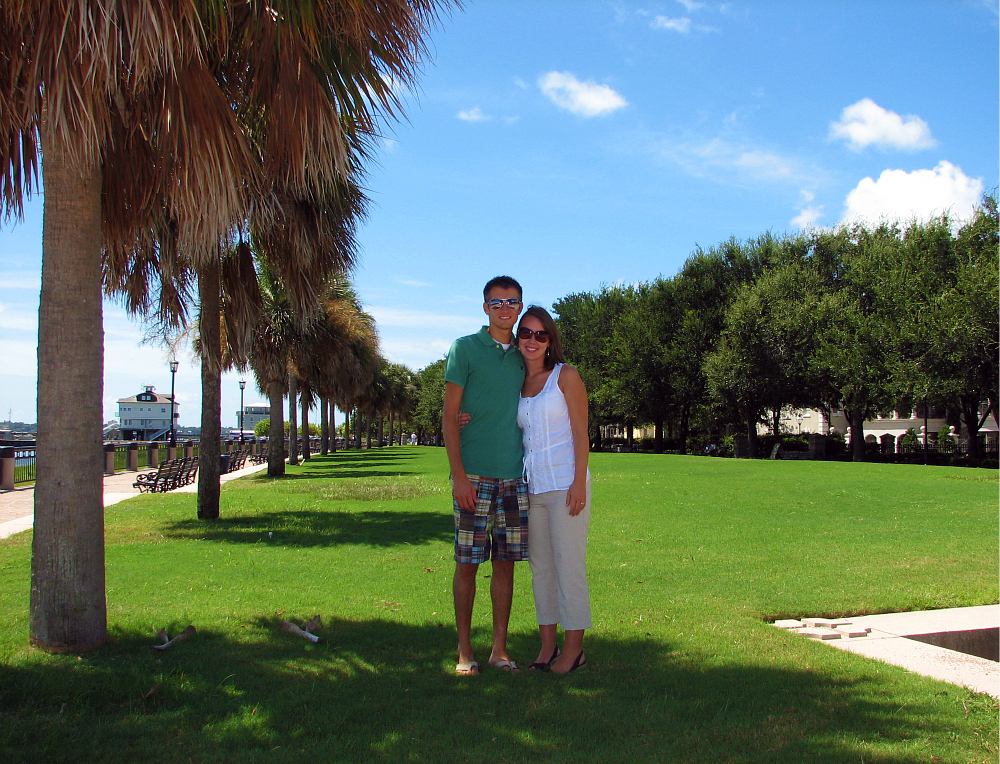
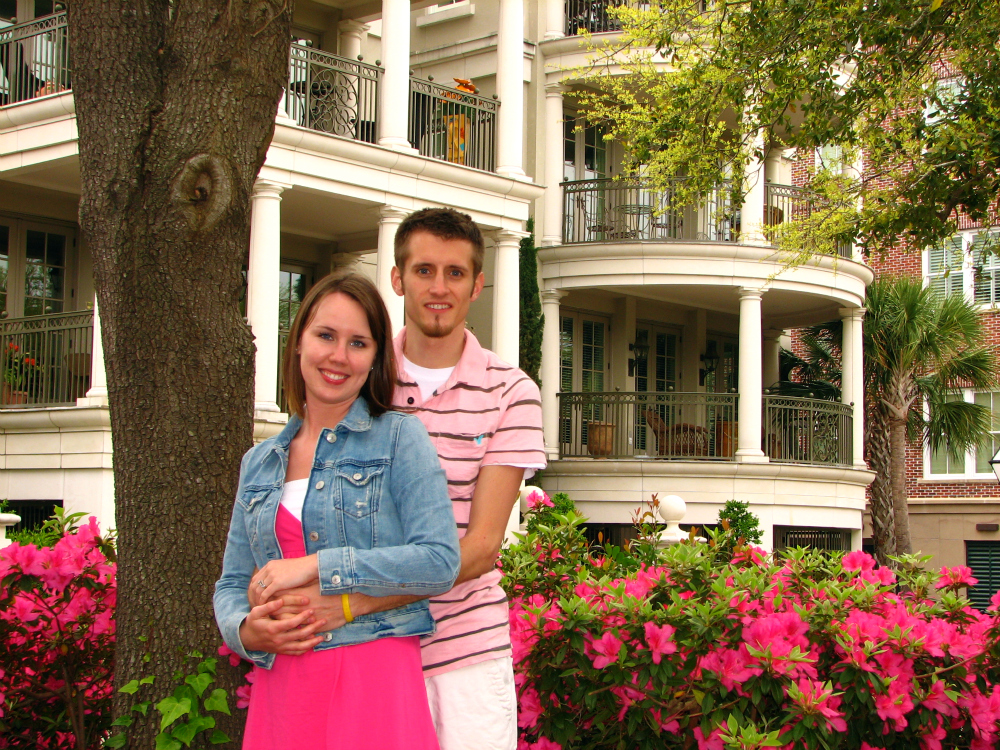
I convinced Stace to pose in front of many of the homes during our walk.

I find it difficult to take pictures of ourselves. At least this one turned out.

This beautiful iron gate is likely the work of Phillip Simmons, the premier blacksmith in Charleston from the 1920's until his death in 2009. It is estimated that close to half of Charleston's ironwork (which adorns nearly every house and church downtown) is the work of Phillip Simmons.

General William Bull's House (c. 1720)
This is one of the oldest homes in Charleston. It was built more than 10 years before George Washington was born.

Preservation Society of Charleston placard for the house

Stace in front of the James Simmons House (c. 1760)

The original hitching post (bottom left) and stepping stone (bottom center) for visiting carriages are preserved outside this home. This house sold for $7.375million in 2009, the most expensive residential sale in downtown Charleston history at the time, though several our currently on the market for far more.

The placard

The George Eveleigh House (c. 1743)
The three original mooring posts outside the house remind an onlooker that this home was built along on a creek bank. It is now set several hundred feet away from the water. The home just sold for $4.2million, after being on the market for the first time in 130 years!

The placard

I tricked Stace into thinking she needed to fix her shirt for this picture, in order to snap a quick candid. I like how it turned out.

Perhaps the most coveted piece of real estate in all of Charleston, at the corner of East Battery and South Battery Streets. The Louis deSaussure House (c. 1858, renovated in 2011) overlooks Charleston Harbor and, like many homes along The Battery, was a front-row seat to the seizure of Fort Sumter within the harbor on April 12, 1861, effectively beginning the American Civil War.

A carriage tour passes in front of the house. This particular driver's name is 'Steve' and was our tour guide during our carriage ride when my family visited last August. We saw him on numerous occasions this day on our jaunt around the city.

White Point Gardens
It was at this spot, once open marsh, that the famous pirate Stede Bonnet, an accomplice of Blackbeard's, was hanged on December 10, 1718 - his body left on the noose for days as warning to other pirates.

The Heyward-Washington House (c. 1772)

It was here, in May 1791, that President George Washington stayed during a week-long visit.

Though in the middle of a renovation, this house still shares a common trait of many historic buildings in downtown Charleston. The Earthquake of 1886 caused many of the buildings to lean on their foundations.

St. Philip's Episcopal Church (c. 1836) also leans slightly (here, to the right) as a result of the 7.0 earthquake.

It was also used as a target for Union ships during the Civil War

The steeple of St. Michael's Church (built in 1752) along Broad St.

Crossing over the Ravenel Bridge into Mount Pleasant to do some shopping...Stacie's main goal for Saturday's outing. :)

Old Glory

In God We Trust!
































0 comments:
Post a Comment